
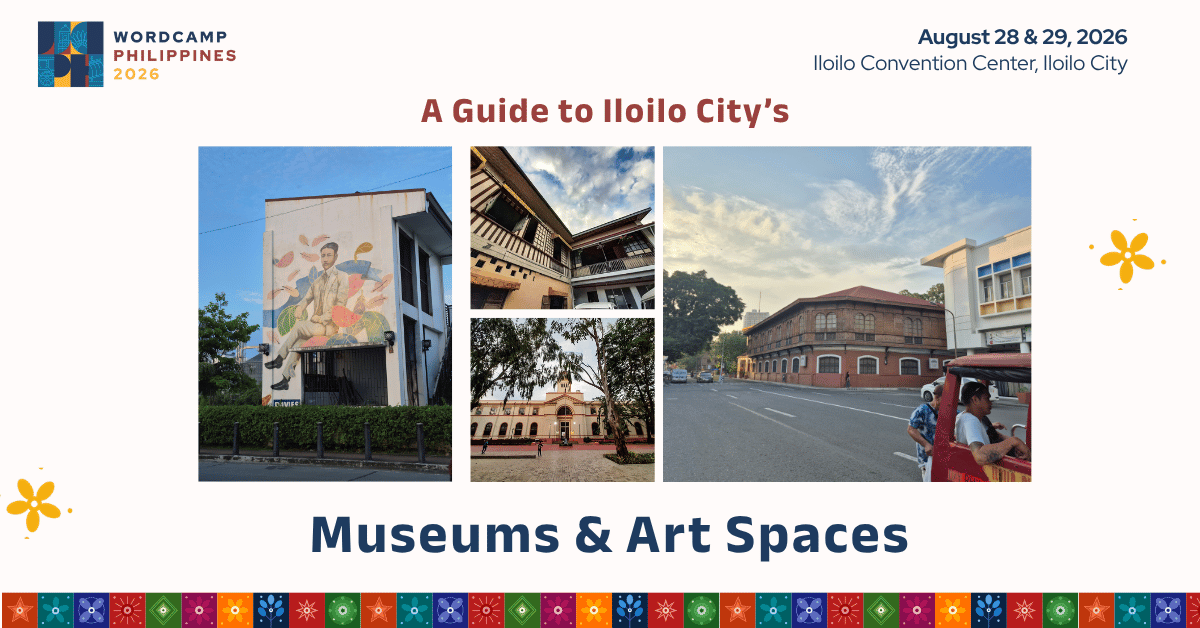
As an Iloilo City local, I’m proud of my home city for the many things it happens to offer: walkable streets, warm people, and, by golly, the food!
Of course, what kind of local would I be if I didn’t rep the city’s heritage and art culture? As any good student of anthropology knows (and yes please, just go along with it. It’s fun, you know.), heritage and art are two facets of culture that are nigh-near inseparable with each other.
Among all the Philippine cities, how is it possible for Iloilo City to have been blessed with the best of both mediums of human expression?

A City Set in Two Eras
The Philippines was a colony of the Spanish Empire from around 1565 to 1898. Like with almost all colonies of the major world powers at the time, port cities have also developed in the country, including Iloilo from the mid-1800s.
During the last months of Spanish rule in the country, Iloilo City became the country’s capital. As reward for its loyalty, the Queen Regent Maria Cristina even granted Iloilo City the title, “La Muy Leal y Noble Ciudad” (The Most Loyal and Noble City), before the Spanish’s eventual ouster from the country.
For a while, the Philippines enjoyed a brief taste of self-governance before the United States attempted to colonize the country in a bloody war that marked the country’s tumultuous entry to the 20th century.
The United States, of course, eventually succeeded in its attempt. From there, they supercharged the city’s development to include dedicated routes from the harvests of sugar-producing Negros Island for export, the installation of a revolutionary phoning and telegraph system, a railway project, and various infrastructure and commercial interests.
Because of its status as an international port, it’s unavoidable that Iloilo will also be influenced by the outside culture coming into its environs. Despite that, the city remains defiantly traditionalist, at least in its business culture.

What do I mean by that? Well, it’s instances like encountering a random neoclassical building that looks straight out of the 1920s when going to a meeting. It’s getting to the said meeting and then eventually relying on the word of your partner that you can buy stuff from a shop located in an alley with an address that isn’t even registered on any mapping service.
It’s old-school social norms going against contemporary efficiency. As I see it, it is this friction between tradition and modernity that defines Ilonggo culture until now.
Now that we’ve had that short history lesson out of the way, we come to the fun part: the exploration!
Iloilo City’s Historic Districts
Iloilo City is a beautiful patchwork of districts, each with its own unique story and character
For starters, we have Mandurriao, arguably the current “business district” of Iloilo City. It is home to our official venue, Iloilo Convention Center, as well as Iloilo Business Park, Festive Walk, SM City Iloilo, Smallville, hotels, restaurants, cafes, and hangout spots.
Second is neighboring Molo, known for its historic church, its beautiful plaza, ancestral homes, and its connection to the famous dish, pancit molo.

Jaro is home to Jaro Cathedral, its freestanding belfry, a historic plaza, and several prominent heritage houses.
La Paz is closely associated with La Paz Batchoy, its public market, and traditional coffee culture.
For the truly adventurous, you can go to City Proper (also colloquially known as “downtown”), where markers of the old Iloilo City abound everywhere from Bonifacio Drive (home to Iloilo Provincial Capitol, Casa Real, and the National Museum) to Calle Real, which hosts Plaza Libertad, historic commercial buildings, the renovated public markets and, for the next thing to tackle, the museums.
A Brief List of Museums and Heritage Houses in Iloilo City
An old tourism tagline for Iloilo City was it’s supposedly a place “where the past is always present”. Nothing proves this more than the presence of several highly distinct museums and publicly-open heritage houses strewn throughout the city.
Perhaps the most popular museum here is the National Museum of the Philippines (NMP) – Iloilo, which also happens to be one of our Community Partners!

The lore behind it is just as fascinating: the current building where NMP is located is actually an old provincial jail constructed in 1911. We’re just conjecturing, but we’d like to imagine many ghost stories have already been told here.
The unique thing about the museum culture here, though, is that there’s a “niche” for every historical interest you might have. For instance, we even have museums detailing trade and maritime history!
We’re listing out each major museum’s and heritage house’s info in table form (because we’re nerds like that, #iykyk), so you can choose where to start visiting:
| Museum / Heritage House | Contact Details | Address |
| National Museum of the Philippines – Iloilo | iloilo@nationalmuseum.gov.ph | Bonifacio Drive, Iloilo City Proper, Iloilo City, Iloilo |
| Museum of Philippine Maritime History | mpmh@nhcp.gov.ph | District, Aduana Building, Iloilo River Wharf, Muelle Loney St, Iloilo City Proper, Iloilo City |
| Museum of Philippine Economic History | mpeh@nhcp.gov.ph | JM Basa St, Iloilo City Proper, Iloilo City, Iloilo |
| The Molo Mansion (Yusay-Consing Mansion) | facebook.com/themolomansion | Yusay-Consing Mansion, 2 Locsin St, Katilingban, Molo, Iloilo City, 5000 Iloilo |
| Camiña Balay nga Bato | +639478911467 | 20 Osmeña St, Villa Arevalo District, Iloilo City, 5000 Iloilo |
| Casa Mariquit | 20 Santa Isabel St, Democracia, Jaro, Iloilo City, Iloilo | |
| Nelly’s Garden (Lopez Heritage House) | nellygarden.events@gmail.com | Brgy E Lopez St, Jaro, Iloilo City, Iloilo |
| The Celso V. Ledesma House | 37calleortiz@gmail.com | Mansion de Celso-Ledesma, Cor. Rizal, Ortiz St, Iloilo City Proper, Iloilo City, Iloilo |
The Art Culture in Iloilo City
Despite its claims to being a “heritage town”, Iloilo City has a surprisingly vibrant art culture. And I’m not just talking about the paintings hung inside a gallery; murals of different visual styles made by different creators can be seen in almost any part of the city, whose ideas are exposed to just about any passerby who’s just going through their day.
In addition, indoor malls, which have served as convenient gathering spots for people wanting to avoid the tropical Philippine heat, are also organizing art exhibits for both solo artists and artist collectives.

So, while we’re focusing on the art galleries that boast physical spaces for simplicity’s sake, it behooves us as locals to give a shoutout to some of the more prominent art collectives in the city:
- Kikik Kollektive, formerly known as Artivism Iloilo, an independent collective known for creating visual and installation art pieces with a focus on rootedness, community, and the championing of non-commercial public spaces
- Bureau, an art collective with roots in street art and the local counterculture scenes
- Himbon, a community-centric collective whose works are often widely exhibited in just about any large-scale event
So, what art galleries should you visit first? Well, let’s start with two of the most widely-known galleries today: the Iloilo Museum of Contemporary Art (ILOMOCA) and Thrive Art Gallery.
In terms of scale, ILOMOCA in Festive Walk, Megaworld is the biggest art gallery in the city. It boasts three floors filled with the rarest and most cutting-edge works from both their featured contemporary artists and from the Adoracion Valencia Gallery, a space dedicated to the private collection of one of the gallery’s co-founders.

Thrive Art Projects (one of our Community Partners. Check out our spotlight of them soon!), on the other hand, has a sparser space, in comparison. However, as it is located centrally in the Shops at Atria, it’s one of the more accessible jump-off points for starting your exploration of the Iloilo art scene, whether you choose to visit one of their monthly exhibitions, or if you just choose to hang and talk with the artist-and-curator owners of the space!
Just like with the museums, we’re listing some of the most visible art spaces located in the city, also in table form!
| Art Space | Contact Details | Address |
| Iloilo Museum of Contemporary Art | https://www.facebook.com/ILOMOCA | Casa de Emperador Festive Walk Parade, Mandurriao, Iloilo City, Iloilo |
| Thrive Art Projects | thriveartorg@gmail.com | The Shops at Atria, Donato Pison Ave, Mandurriao, Iloilo City, 5000 Iloilo |
| UPV Museum of Art and Cultural Heritage | +63333158556 | University of The Philippines Visayas, Ybiernas St, Iloilo City Proper, Iloilo City, 5000 Iloilo |
| Museo Iloilo | museoiloiloicrfiofficial@gmail.com | Iloilo Provincial Capitol Complex, Bonifacio Drive, Barangay President Roxas, Iloilo City Proper, Iloilo City, Philippines, 5000 |
| The Homegrowns | +639461808416 | 53 Arguelles St, Jaro, Iloilo City, 5000 Iloilo |
| Balay Sueño | +639548273958 | Washington Street, Jaro, Iloilo City 5000 Iloilo |
We hope you’ve caught up! This is far from an extensive list, but we believe it’ll be enough to spur you on your little Iloilo culture adventure. And besides, the best places are the ones you discover by yourself.
If you want to submit a listing or are planning a Side Event, then go to this page here!
In the meantime, we hope you’ve already brought your tickets to WordCamp Philippines. If you did, then see you!
With additional writing from Rolly Bueno, one of our WordCamp PH organizers for this year
